Ask any founder who’s shut down a company, and rarely will they say “we ran out of ideas.” The real reasons why startups fail are almost always more boring, and more avoidable, than that.
Running Out of Cash Before Finding Product-Market Fit
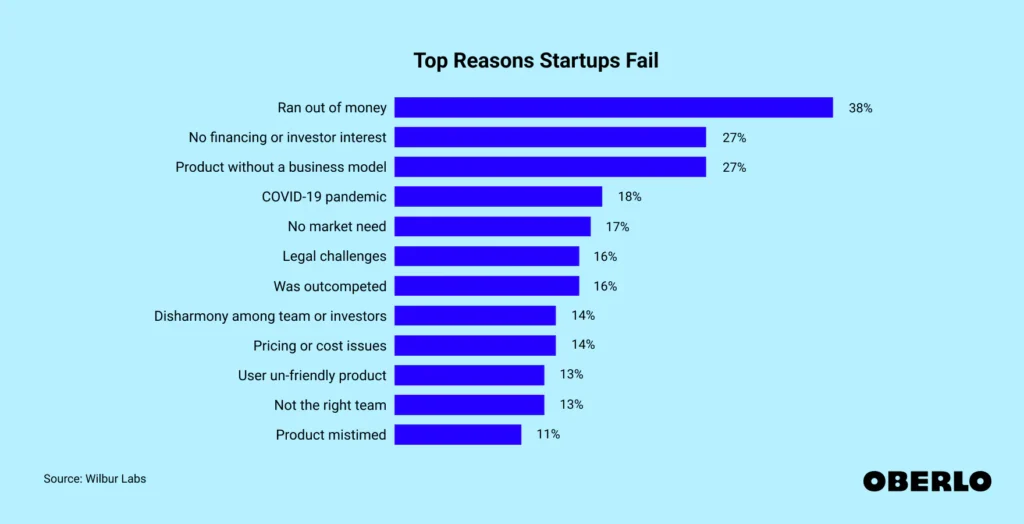
This is the classic one. Founders build, launch, and burn through money faster than they gain paying customers. By the time they realize the product needs a real pivot, there’s nothing left to fund it.
In short: most startups that fail don’t die from bad ideas — they die because they run out of cash before proving anyone actually wants to pay for the idea.
Building for a Market That Doesn’t Exist Yet
Sometimes the idea is genuinely good, just five years too early. The infrastructure, customer awareness, or trust needed for the product simply isn’t there yet, and no amount of marketing budget fixes timing.
Ignoring Early Customer Feedback
I’ve seen this one up close — a founder friend kept adding features nobody asked for while ignoring the one complaint that came up in nearly every customer call. By the time they addressed it, several customers had already quietly left.
Co-Founder Conflict
This reason rarely makes it into the polished post-mortems startups publish, but it’s one of the most common causes why startups fail. Mismatched expectations around workload, equity, or decision-making authority quietly poison a company from the inside.
Scaling Too Early
- Hiring a large team before revenue justifies it
- Expanding to new cities before the first city is even profitable
- Spending heavily on marketing before the product retains users
Growth that outpaces actual demand tends to collapse under its own weight.
Weak Unit Economics
If a startup loses money on every single sale and hopes volume will somehow fix that later, it’s usually building toward a wall, not a business. Volume makes bad unit economics worse, not better.
No Clear Differentiation
Picture a food delivery startup launching in a mid-sized Indian city with pricing and features nearly identical to two existing players. Without a genuinely different angle — faster delivery, better margins for restaurants, a niche cuisine focus — there’s little reason for customers to switch.
[link to related guide about validating product-market fit here]
Founders Who Stop Talking to Customers
Once a product launches, some founders shift entirely into “building mode” and stop having regular customer conversations. That disconnect is often where the first cracks in a startup begin, long before the financials show it.
[Suggested image alt text: “founder analyzing reasons for startup failure on a whiteboard”]
FAQ
What’s the single biggest reason startups fail? Running out of money before reaching real product-market fit tops most founder surveys and post-mortems.
Does a great product guarantee a startup won’t fail? No — distribution, timing, and unit economics matter just as much as the product itself.
Can co-founder conflict really sink a startup? Yes, it’s one of the most underrated reasons why startups fail, often more damaging than external market conditions.
How can a founder avoid scaling too early? Wait for consistent, repeatable demand signals before hiring aggressively or expanding into new markets.
Is it normal for a startup to pivot in year one? Very normal — many successful companies today look nothing like their original year-one idea.
Conclusion
Most of the reasons why startups fail aren’t mysterious or dramatic — they’re avoidable mistakes around cash management, customer listening, and timing. If you’re building something new, treat year one as a listening exercise as much as a building one. The startups that survive tend to be the ones that stayed closest to their actual customers, not the ones with the flashiest launch.